It's not living alone if you keep a rifle under the bed.
- Chuck Palahniuk
Tuesday

Aftermath, Inc. Excerpted

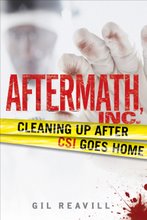
The excellent literary periodical Maxim just contracted to excerpt Aftermath, Inc.: Cleaning Up After CSI Goes Home in its May issue. Editor Jason Kersten (a brilliant writer in his own right, and author of The Journal of the Dead) called the book "a crime classic" and is putting together a crime-photo heavy lay-out. So everybody out there who insists they only look at Maxim for the photo spreads will have something to read.
Monday
Mike S. Ryan on Misguided Liberals

Check out our pal Mike S. Ryan (Junebug, Palindromes, Forty Shades of Blue) on the perils of soft-headed, well-intentioned thinking in his post on Grace Is Gone, a new John Cusack film that premiered at Sundance.
"Donald Rumsfeld and all pro-war Republicans will love the new John Cusack film, Grace is Gone. Others, some whom may be liberal, agree: it could be a crowd-pleaser able to reach beyond the indie ghetto. It was bought earlier this week for $4 million.
"Rumsfeld will love how the film shows a family coping with the grief following the death of the family's soldier mom. There is no anger at the film's end; we are left feeling that this grief will be healed. The film offers a positive portrait of how a family can pull together in such sad circumstances.
"Rumsfeld will love how the film's one dissenting, anti-war perspective is mouthed by a clichéd liberal couch potato. Alessandro Nivola plays a 31-year-old bearded lay about. We see him in mid-afternoon on his mother's couch, dozing off in front of cartoons. This liberal also has unfocused opinions, no ambition, and is really only concerned with eating. And being unable to pay for his own meal, living in his mothers home, he is seen as mooching off the system.
"Rumsfeld and most Republicans will agree with Cusack's response to his older daughter's questions about the war. To question the value of the war would lead one to a scary place, "we'd be lost," he says. Better to stay the course and trust that the government has our best interests in mind.
"Cusack may think that by showing grief and the pain of a soldier's loss, he's made an anti-war film. He couldn't be further from the truth. In fact, he may have inadvertently made a pro-war, pro-Bush film. I think all Republicans will endorse Grace Is Gone; it does not question the war's purpose, instead it focuses on how the country will get through this difficult period.
"Assuming the filmmakers are liberal -- and don't intend to come off as supporters of Bush or the war -- how do we explain these sloppy aesthetics? The filmmakers have said they want to reach the biggest audience possible; they feel the subject of their film is nonpartisan. Truth is, though, there is nothing nonpartisan about the war: you either support it or feel that it was a tragic mistake, one that has resulted in countless innocent Iraqi and American deaths.
"The 'nonpartisan' excuse is really just a cover-up for the fact that the goal of the film is to make as much money as possible. Profit drives its aesthetics, just like profit has driven this war. In this sense the film is the worst kind of exploitation film -- a film that profits off the unjust deaths of innocents is a heinous, odious thing. Like war profiteers Rumsfeld, Cheney, Rice, and Bush, the filmmakers proceeded ahead without truly and fully thinking out their strategy and understanding the consequences of their choices. But as with Halliburton and Bechtel, their choices will very likely result in enormous profits for them and their clan.
"Shame on all war profiteers. And please, let this be a warning to all liberally minded filmmakers: let's think out our choices carefully before proceeding with a war-themed film. We may end up doing more harm than good."
Read all the comments on the Filmmaker Magazine site to gauge what a tempest Mike stirred up.
Murder of Crows on 2/02/2007
Even when you work on a movie doing only the BTS (behind the scenes) documentary coverage, it can be years before you see anything on screen, and I mean, any kind of screen, whether it be on the interweb or mobile phone screen.
So, alas, The Messengers, directed by Danny and Oxide Pang, is hitting theatre screens, finally; and all the BTS I (Eric) produced and directed on it is out there somewhere in the digital ether.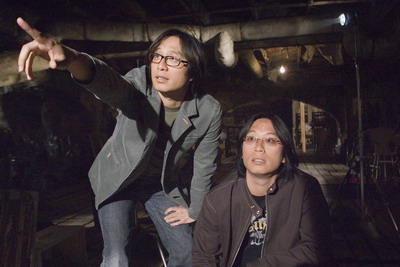
Here are a few links to see my work for the movie: The Messengers Webisode "Pang Vision"
( go to the "video" section ) And... Ghost House site (Mr. Rami's horror production Co)"
I directed 10 webisodes and 10 mobisodes (for G3 phones in Europe and Asia.) but because of the unknown vagaries of the movie industry only certain BTS webisodes are still around – one main reason is the webisodes gave away a lot of details about the story and effectively were spoilers, revealing too much about how scary the movie is. Also, they re-shot and changed the movie a whole bunch after I did webisodes on principal photography.
One thing I liked about checking these tag-team directors in action is, that besides pinch hitting for each other in the directing dept. (one brother one day and the other brother the next day in the director’s chair), these twin-bros directors would direct a scene, even a single beat, according to how they saw it edited in their head. So, on set, you’d invariably here Danny or Oxide yell “Cut,” right in the middle of an actor’s performance of a line because they knew they’d be on someone else’s face in the editorial; then, they'd move on to the next set-up on their shot list.
I knew about this directorial style as a way to save money in production from reading about Hong Kong films, but to see it in action really blew my mind. It blew the actor’s minds to say the least. I think it might be the first Hollywood film that was directed in this style.
Saturday
Still Our Favorite Review

Dirty
A Silver Nitrate Releasing release. Produced by David Hillary, Tim Peternel. Executive producer Ash Shah. Co-producer, Tierre Turner. Directed by Chris Fisher. Screenplay, Fisher, Gil Reavill, Eric Saks.
Salim Adel - Cuba Gooding Jr.
Armando Sancho - Clifton Collins Jr.
Lieutenant - Cole Hauser
Baine - Wyclef Jean
Capt. Spain - Keith David
Brax - Wood Harris
Roland - Robert LaSardo
Manny - Lobo Sebastian
Taboo - Ramirez
Splooge - Khleo Thomas
Rita - Aimee Garcia
(English, Spanish dialogue)
By ROBERT KOEHLER
The cop genre receives a shot of adrenaline in helmer Chris Fisher's "Dirty," a no-nonsense dramatic response to the LAPD Rampart scandals of the '90s. Pairing a transformed Cuba Gooding Jr. and Fisher favorite Clifton Collins Jr. as morally compromised beat cops enduring a bad day on the streets is just the start of film's smart moves. By handing theatrical release reins (for spring opening) to exec producer Ash Shah's Silver Nitrate, Sony has missed an opportunity to earn serious coin with a pic that should have terrific crossover appeal among multicultural aud niches, though studio (which holds vid rights) will enjoy bang-bang ancillary returns.
Though it was never conceived as the finale of a trilogy, Fisher's latest completes a rough and very raw cycle of Los Angeles crime movies, starting with true-life serial killer dramas "Nightstalker" and "Hillside Strangler." While he retains certain touches of shock and horror -- along with a decibel-busting soundtrack -- from earlier pics, Fisher takes huge strides forward in "Dirty," fashioning a complex morality drama that overshadows films with similar themes from "Training Day" and "Crash" to "Dark Blue."
Collins' Officer Sancho narrates, in classic Los Angeles cop fiction style, the story of his dangerous transformation from gangbanger to cop. But on a sunny, yet grimy, day (brilliantly and seamlessly lensed in smog-stained color by Eliot Rockett and Danny Minnick), Sancho is on the brink of coming clean with LAPD's Internal Affairs department about his involvement in drug-related corruption in his division, led by Capt. Spain (Keith David).
Sancho's partner Adel (Gooding), so thoroughly corrupt that his upside-down nametag is a symbol of his rottenness, has no idea that Sancho is talking to IA cops, who are also investigating Sancho for accidentally killing a bystander during a shootout.
Spain, along with his nefarious Lieutenant (Cole Hauser), view the gang-infested streets as a war zone where any tactic is suitable, even if it includes ordering Sancho and Adel to remove a 13-kilo bag of heroin from an evidence room to frame Canadians horning in on the business of drug kingpin Baine (Wyclef Jean). Sancho rightly views the assignment as rife with traps, but he can't control Adel's urges to harass and abuse civilians, from white out-of-towners to Venice homies.
For a movie that stays true to its low-budget roots as a decidedly prol genre work, "Dirty" draws a vast panorama of Los Angeles street life and the similar hierarchies that rule black and Mexican gangs as well as the LAPD. There's always some higher authority to answer to, just as there's always another hidden agenda designed to bushwhack the unsuspecting foot soldiers, whether or not they wear a badge. It's this parallel of criminal and law enforcement elements, along with its pointed portrait of non-Anglo cop partners on quite different moral paths, that distinguishes pic from other recent genre works.
Just as a certain fate seemed to hang over the serial killers in his previous thrillers, a dark cloud looms over Fisher's cops here. This inevitability unfolds with genuinely tragic power, not only because of Fisher's confidence in his material but also because of Gooding and Collins' lusty embrace of their roles.
Collins adds to his fascinating gallery of portraits of bad men -- or, in this case, extremely flawed men -- internally tortured by their actions, but Gooding is a revelation. His Adel is a nasty and self-hating cop who has been so undone by what he's witnessed on the beat. It's just the tonic for an actor who has drifted into too many goody-goody roles since "Jerry Maguire."
Supporting cast is studded with extremely vivid perfs, including the always magnetic David in his best role in years, Jean in colorful overdrive (and speaking a Jamaican patois that's subtitled) and Robert LaSardo dominating a finale sequence rife with unbearable tension.
Pic looks and sounds fabulous, with Fisher showing off his love of soundtracks layered with noise, quiet and bone-rattling music. Los Angeles is a major star in the film, and with no iconic or familiar sights on view, it's framed as only a local is able to.
Camera (color, Super 16mm-to-35mm), Eliot Rockett, Danny Minnick; editor, Tracey Wadmore-Smith; music, Peter Lopez; music supervisor, Greg Danylyshyn; production designer, Anthony Rivero Stabley; art director, Chris Davis; costume designer, Johnny Wujek; makeup effects designer, Robert Hall; sound (Dolby Digital/SDDS/DTS), Jim Dehr; sound designer, John Marquis; supervising sound editor, Marquis; special effects supervisor, Chris Bailey; visual effects, Digital Domain; supervising stunt coordinator, Dain Turner; police technical adviser, Chris Craig; line producer, Richard Middleton; assistant director, David Cluck; casting, Shannon Makhanian. Reviewed at AFI Los Angeles Festival, Nov. 10, 2005. MPAA Rating: R. Running time: 97 MIN.
Curtain of Pink Death

"Hey, what's up with that curtain thing?" asked a fellow human being about our signature image on emails and posts. Curtain of Pink Death Productions is an umbrella d/b/a for our movie and screenplay work. And "curtain of pink death" was the sobriquet that referred to the nether parts of a mutual girlfriend of ours. But the image itself Eric found on the web, provenance unknown. Or maybe it appeared to him in a dream. Meditate on it long enough, and you will find yourself eternally marooned in a hallucinatory bardo in which mimicry passes for life.
A view of a generic biege-pink brick-shuttered McMansion seen through a window on a lightly stained recently curbed concrete street, with a curving sidewalk nobody ever walks on leading across a threadbare, newly re-landscaped lawn. The naked shivering tree, a brutalist marker for housing development existentialism. The pot of flowers, a lone bit of color, to the left of the front door, looking as though it were dropped off there by a realtor lady working on half commission. Blank-faced double-garage doors, hiding either a meth lab or a collection of never-ridden bicycles, des vélos de ville solides, conçus pour la rue.
And then, on this side of the belvedere, the curtain itself, draped and tied in a uterine way, suspended from a faux-brass rod from Home Depot, occluding washed-out, insipid, afternoon light from the biege-painted drywall of an unseen room. "What cannot be said," wrote Jim Harrison in his notebook, "will get wept."
In the bottom left corner, a digital date stamp in red: 2006 4 27. Of no significance, unless you remember April 27 was the day Kepler fixed upon as the date for the creation of the universe, in 4977 B.C., which would be 6,983 years before this snap was shot. Could the precise timing of the curtain of pink death photograph indicate the re-birth of the universe into a new, all-biege, all-homeostatic reality? Or was the date stamp merely an ironic comment on the detached, still-born suburban meringue in which our countrymen's lives have become irretrievably clotted? You decide.
To come: the CGI animated version of the image, with the curtain billowing in a hand-of-God wind, courtesy of Eric Saks.
Thursday
Old Poem

Gil: I turned this up sifting through old papers recently. I wrote it in college, at the University of Colorado. My writing teacher at the time, the poet and playwright Sidney Goldfarb, said this poem would "be remembered when someone like Robert Creeley is long forgotten." He was wrong, but it was quite a generous thing for him to say. I don't know what he had against Creeley. Pagoda Mountain is in Rocky Mountain National Park, above Boulder. It's in the middle of the photo above right.
THE WINDS AROUND THE PEAK OF PAGODA MOUNTAIN
Down from the peak of Pagoda Mountain, winds blow
Clouds the color of honey across the rough face.
We've come to Sandbeach Lake to spend the night,
And sprawl on the sand, laughing loud drunk
Or fiercely preserving the silence. Four or five
Rainbows idle in the shallows, a mongrel cries
In the jackpines by the shore. We count stars
As they come out, one, two, suddenly
We hallucinate thousands, blinking
And slipping out from under our count
Like trout. We drink more wine, forget
About the sky, never notice when the winds
Around the peak of Pagoda Mountain
Blow loose the stars into darkness.
The roly-poly Goldfarb and I had a somewhat tortured history subsequently. He took off for Europe on a summer sabattical in 1979, and had me house-sit his cabin in the canyons above Boulder, near a small hippy hamlet called Wall Street. Sidney had already left when I moved in, and the first thing I noticed was that his stereo and all his record albums had vanished. A bad omen at the beginning of my stewardship, but I sort of fecklessly considered that perhaps Sidney had taken his tunes with him to Europe (or Yurrup, as Pound used to spell it). I spent an idyllic time at his cabin. We had a lot of wine-stained dinners and created a sweat lodge in the mouth of an old mine-shaft just up the draw from the cabin. Things might have gotten away from me. When the estimable Professor Goldfarb returned from estivating abroad, he was dismayed to discover that the front door to his cabin was wide open with no one at home. An oversight on my part. He discovered his albums missing, and other irregularities: a few colorful woolen blankets he had purchased in Mexico were now stained with black charcoal, a consequence, I fear, of our sweat lodge adventures. Goldfarb cooled to me. In fact he never spoke to me again, and gave me the stink-eye whenever we passed each other on campus. A friend of mine, whom he picked up hitchhiking, made the mistake of telling him that she knew me. He pulled over to the side of the road and made her get out of his car.
That "mongrel" in line six has a story behind it. A group of friends, Paul Rogers among them, did indeed head for Sandbeach Lake one weekend to ingest hashish and forget how to count. Paul brought his dog Oliver along. Strictly forbidden to have dogs within the confines of the park, of course, a Federal rap, in fact, if you're caught. So on the way up we concoct a story, agreeing on a false address in case we were stopped. We enjoy a glorious night at Sandbeach Lake, and Oliver howled at the coyotes in the Ponderosa pines ("jackpines" scanned better, even though there is none in the park). On our way down the trail the next morning, sure enough, we encountered a park ranger. He busted us on the dog. Summoned each one of us away from the others down the trail twenty yards, giving us the fifth degree to see if our stories matched. They did, fake address and all, except I forgot the agreed-upon house number. Oops. Smokey wrote us all summonses and let us go, after verbally ripping into us with righteous naturalist anger.
Subscribe to:
Posts (Atom)